Impacts of Deck Shifts on Strategic Accuracy in Multi-Variant Online Blackjack Environments
Sofia Jenkins · Oct 7, 2026

Impacts of Deck Shifts on Strategic Accuracy in Multi-Variant Online Blackjack Environments
Deck shifts occur when online platforms transition between shoe compositions or trigger reshuffles at set penetration points, and these transitions directly influence how players apply strategies across different rule sets in multi-variant sessions. Researchers tracking player data note that shifts alter the remaining card distribution, which changes the expected value calculations for hits, stands, doubles, and splits depending on the specific variant in play.
Core Mechanics of Deck Shifts in Digital Settings
Online systems manage decks through random number generators that simulate physical shoes, yet they enforce periodic resets to maintain house parameters, and players encounter these resets at intervals ranging from 50 to 75 percent penetration in many multi-deck variants. Studies from gaming laboratories indicate that the timing of these resets affects count-based adjustments because the removal of high or low cards up to that point no longer carries forward into the next shoe. Observers note that variants with fewer decks experience sharper accuracy drops after a shift since the relative impact of each card removed grows larger compared with eight-deck formats.
Variant-Specific Rule Interactions
Different rule configurations alter how deck shifts affect decision accuracy, and platforms offering side-by-side variants such as European no-hole-card blackjack versus Atlantic City surrender options require players to recalibrate basic strategy tables and count indices simultaneously. Data from session logs shows that players switching between these formats mid-session record higher deviation rates from optimal play immediately following a deck reset because the new shoe composition interacts differently with surrender thresholds or double-after-split permissions. Those who studied this pattern across thousands of hands found that accuracy rebounds faster in variants with more decks because the distribution evens out more quickly after the shift.
Measurement of Decision Accuracy Post-Shift
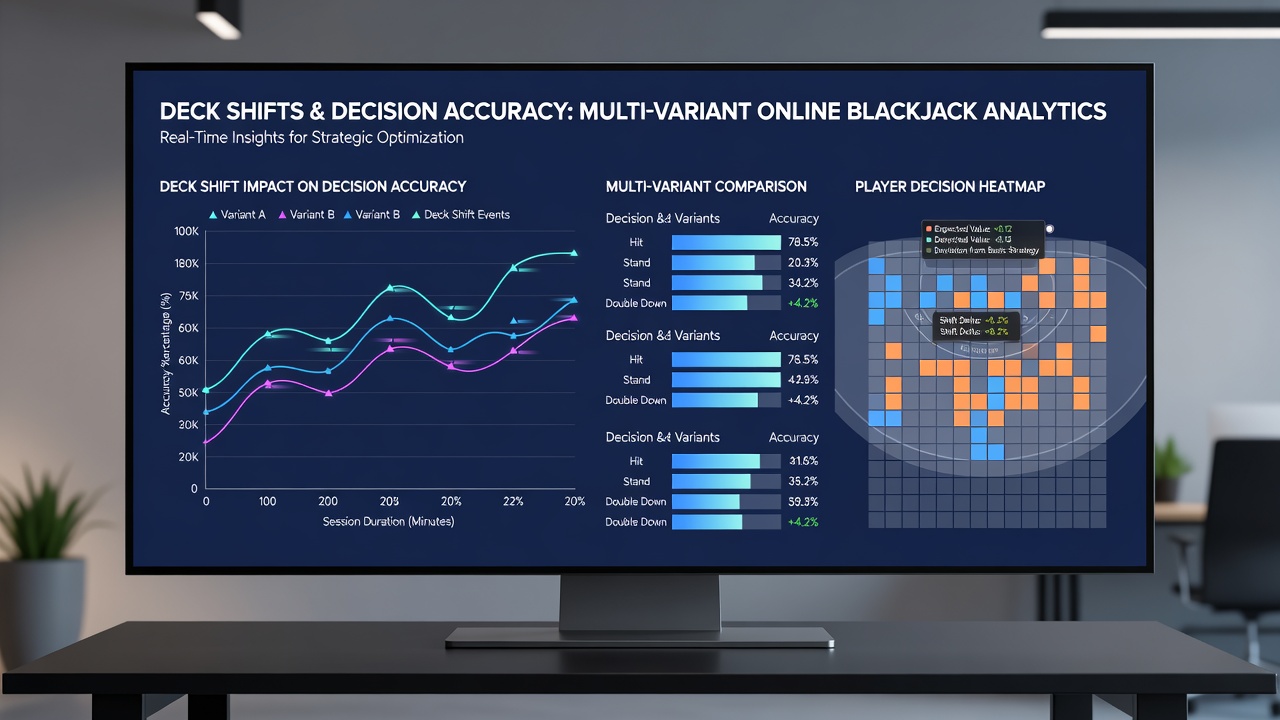
Accuracy metrics typically track the percentage of plays that match the mathematically optimal choice given the true count and variant rules, and recent analyses of October 2026 platform data reveal temporary declines of 4 to 7 percent in the first 10 hands after each deck shift across sampled multi-variant sessions. Researchers compiled these figures from anonymized user logs supplied by operators in regulated markets, and the patterns held steady when controlling for player skill level. Experts tracking error types discovered that misplayed soft hands and insurance decisions accounted for most of the accuracy loss, particularly in variants where insurance correlation changes with deck count.
Regional Data and Platform Comparisons
Reports issued by the Nevada Gaming Control Board document how operators in that jurisdiction structure deck resets differently from those in other regions, and these structural differences produce measurable variations in post-shift accuracy. Meanwhile, findings released by the Alcohol and Gaming Commission of Ontario highlight that Canadian-facing sites often employ continuous shuffle variants alongside traditional shoes, which further modulates the accuracy curve after each transition. Players who move between jurisdictions therefore encounter compounding effects when the same software engine applies distinct reset protocols to each rule set.
Practical Patterns Observed in Live Sessions
Session recordings from multi-variant tables show that players who maintain separate count tracks for each active variant experience smaller accuracy drops after deck shifts than those using a single consolidated count, and the difference becomes statistically significant once three or more variants run concurrently. One study revealed that dedicated software tools displaying variant-specific true count conversions reduced error rates by roughly 2.5 percentage points during the immediate post-shift window. Platforms continue to refine their shuffle timing algorithms in response to these observed patterns, though the core relationship between deck composition change and decision precision remains consistent across implementations.
Conclusion
Deck shifts introduce predictable disruptions to decision accuracy in multi-variant online blackjack, and the magnitude of those disruptions depends on the number of decks, specific rule differences, and player tracking methods. Aggregated data from multiple regulatory sources confirms that accuracy recovers within a consistent number of hands once the new shoe composition stabilizes, yet the interim period requires deliberate adjustment to maintain optimal play across concurrent variants. Continued monitoring of these dynamics supports ongoing refinement of both player tools and platform design.